
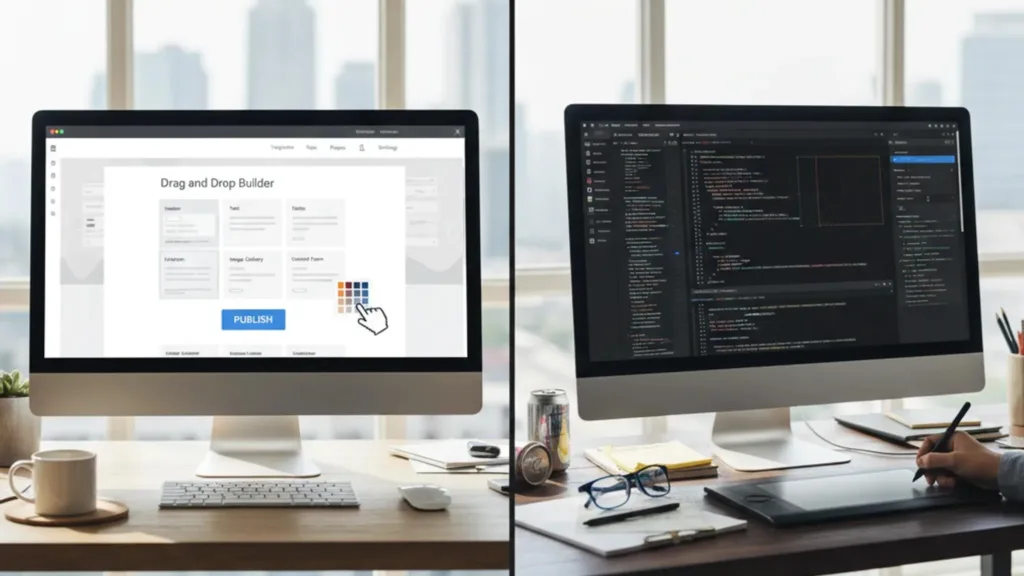
Custom website development vs website builders — which option is better for your business? Both approaches can deliver a modern website, but they differ in cost, flexibility, management capabilities, and long-term growth potential. Website builders such as Wix and Squarespace offer quick launches and ready-made tools, while custom development allows businesses to create websites tailored to specific requirements. The right choice depends on your business goals, budget, and future plans.
Custom Website vs Website Builder: What’s the Difference?
A website builder is a platform that simplifies website creation through ready-made templates and visual editing tools. Users can add pages, modify designs, and configure essential features without programming knowledge.
A custom website is developed according to a business’s specific requirements. Developers can create unique designs, features, and integrations, although the scope and cost depend on the project’s complexity.
Importantly, custom development does not always mean building everything from scratch. For example, WordPress can be used with ready-made templates or customized with entirely unique designs and functionality.
Website Builders: Advantages and Disadvantages
Website builders are particularly convenient for smaller projects that need a simple website launched quickly. Their main advantage is that hosting, editing tools, and many technical features are combined within a single platform.
Main advantages:
- Fast launches using ready-made templates.
- Relatively low initial costs.
- Easy page and content editing.
- Centralized hosting and essential updates.
However, a platform’s capabilities may not always meet specific business requirements. Limitations can arise when implementing complex integrations, creating unconventional designs, or transferring data to another system.
Additionally, monthly subscriptions, premium features, and paid applications can increase the total cost over time.
Custom Websites: Advantages and Disadvantages
Custom development is particularly valuable when a website serves as an essential business tool rather than simply a place to publish information.
Main advantages:
- Design and user experience tailored to business needs.
- Development of specialized features and integrations.
- Greater control over technical architecture.
- Opportunities to plan for future expansion.
For example, custom business website development may include service pricing calculators, CRM-integrated forms, or personalized customer accounts.
The main disadvantages are higher initial costs and longer development timelines. Custom websites also require technical maintenance, security updates, and timely bug fixes.
Custom programming does not automatically guarantee better quality. The result depends on the developer’s expertise and proper project planning.
Cost Comparison: Which Option Offers Better Value?
When comparing prices, consider not only development costs but also the total cost of website ownership over several years.
Website builders typically require a smaller initial investment, but subscription fees, applications, and additional services create ongoing expenses.
Custom websites may cost more initially, but they can reduce dependence on a particular platform’s limitations for certain features.
What Costs Should You Consider?
- Website design and development.
- Hosting, domain registration, and software licenses.
- Updates, security, and technical support.
- Additional features and integrations.
Ideally, compare estimated costs over at least three years. This provides a clearer picture of which solution makes financial sense for your business.
SEO, Performance, and Security: Which Is Better?
Both approaches can produce search-engine-friendly websites. Results depend on page structure, content quality, technical optimization, and user experience.
Google Search Central explains fundamental SEO principles that apply to both website builders and custom-developed websites.
Website Speed and Technical Control
Custom development offers greater opportunities to optimize code, servers, and loading processes. With website builders, some technical settings remain under the platform provider’s control.
To evaluate performance, consider Google’s Core Web Vitals, which measure loading performance, responsiveness, and visual stability.
From a security perspective, website builders often manage infrastructure updates themselves. With custom websites, responsibilities depend on the technologies used and the maintenance agreement.
Which Solution Is Right for Your Business?
Your decision should reflect what you expect from your website today and how you plan to use it in the future.
A website builder is often sufficient if:
- You need a simple informational website.
- Your budget is limited and a quick launch is a priority.
- You do not require complex features or integrations.
A custom website may be better if:
- Your website is a primary sales or service channel.
- You need specialized functionality and automation.
- You plan to expand the project over time.
For example, a website builder may be perfectly adequate for a small company’s presentation website. However, an e-commerce website with a complex product catalog, order management, and integrations may require a more flexible solution.
How to Avoid Choosing the Wrong Solution
Before selecting a platform or developer, list the essential features your website needs and consider potential future requirements.
Check whether you can export your content, retain ownership of your domain, and migrate to another technology. Maintaining control over your data and administrative access is especially important.
You should also determine who will handle updates and technical issues. If necessary, arrange website technical support in advance to avoid unexpected expenses after launch.
Conclusion
Custom website vs website builder — there is no universal answer. Website builders are a practical choice for launching simple projects quickly and affordably, while custom development provides greater flexibility and technical control.
When deciding, consider more than the initial price. Evaluate functionality, long-term expenses, and future growth plans. If you need help choosing the right approach, contact our team to discuss your project requirements.
